No Surprises Act: Protecting Out-of-Network Reimbursement
Friday, September 11, 2026

Can Organized Medicine Learn from Healthcare Consolidation?

Click to Enlarge
Colleagues:
Healthcare today bears little resemblance to the system many of us entered decades ago. Independent physician practices have steadily disappeared, replaced by large health systems, corporate medical groups, and increasingly concentrated health insurance companies. The physician entrepreneur who once owned and directed his or her practice has become the exception rather than the rule. Today, most physicians are employees.
This transformation did not occur overnight. Market forces, declining reimbursement, increasing regulatory requirements, electronic health records, and growing administrative complexity all contributed to the trend. The Affordable Care Act accelerated these changes by encouraging integrated delivery systems, new payment models, and greater organizational scale. Whether those outcomes were intended or not, the result has been one of the most significant consolidations in the history of American healthcare.


No Surprises Act Webinar: Protecting Out-of-Network Reimbursement

Click to Enlarge
The No Surprises Act changed the rules around certain surprise billing situations and created an Independent Dispute Resolution (IDR) process that providers, facilities, and health plans may use to determine payment rates for certain out-of-network charges.
MSSNY and member benefit partner Callagy Recovery are hosting “The No Surprises Act Explained: What Every New York Physician Needs to Know” on September 24, 2026, from 6:30–7:30 PM. This session is designed to give physicians and practice leaders a clear, practical understanding of what the law means for their practice.
The webinar will cover the purpose of the No Surprises Act, when it applies, how out-of-network billing is handled, and what the IDR process looks like from the provider perspective. Attendees will also learn how reimbursement disputes are addressed and what steps may help physicians recognize when they are being underpaid.
This is not intended to be a dense legal lecture. It is a physician-focused discussion for practices that need usable information about one of the most consequential federal laws affecting medical reimbursement today.
The program will feature Fernando J. Valencia, Chief Revenue Officer for Callagy Recovery, a nationally recognized educator and strategist on the No Surprises Act and federal IDR system. He will be joined by Thomas Lee, MD, MBA, Executive Vice President of MSSNY, a board-certified neurosurgeon and longtime physician advocate who helped lead the successful effort to enact New York’s surprise medical bill law.
National Physician Suicide Awareness Day: Make Time to Talk, and to Act

Click to Enlarge
September 17 is National Physician Suicide Awareness Day, a reminder and call to action to make time to talk — and to act — so physicians’ struggles do not become mental health emergencies.
MSSNY is proud to recognize National Physician Suicide Awareness Day by sharing resources that support physician well-being, including suicide prevention resources, tips for starting important conversations about mental health, crisis planning tools, and more.
Together, we must continue working to build a culture of wellbeing in medicine by reducing burnout, safeguarding job satisfaction, removing barriers to mental health services, and destigmatizing seeking care.
Seven actions can help reduce physician burnout and prevent mental health emergencies:
- Learn the vital signs
- Encourage mental health reflection
- Share suicide prevention resources
- Prepare before a moment in crisis
- Check in with a physician
- Remove intrusive mental health questions
- Create a culture of well-being
Everyone has a role in reducing physician suicide. Visit NPSADay.org to learn more and take action.
If you or someone you know is struggling or in crisis, call or text 988 or chat 988lifeline.org.

MSSNY Urges CMS to Reject Medicare Payment Cuts; Please Join Our Efforts!

Click to Enlarge
MSSNY President Dr. Mark Adams, MD, MBA, has submitted a comment letter to CMS Administrator Oz urging that CMS withdraw two very harmful policies advanced in the 2027 Part B Medicare payment rule – measures which will have a significant adverse impact on the ability of community-based physicians to stay in practice and be available to provide needed care to their patients.
The letter urges CMS to reject both its proposal to slash the Medicare conversion factor as well as its proposed policy to reduce payment by 50 percent when a separately identifiable office/outpatient (O/O) evaluation and management (E/M) service reported with modifier -25 is furnished on the same day as a procedure with a 0-, 10-, or 90-day global period. In addition to its own letter, MSSNY has joined in letters from the AMA and the “Big 5” state medical association coalition urging that CMS reject these cuts.
MSSNY’s letter notes that “at a time when it is becoming nearly impossible for many physicians to maintain their own practices and to provide care options for our patients, these proposed measures would force even more physicians to become system employees or retire altogether.”
Physicians can join in these efforts by sending letters opposing these cuts here and here. MSSNY is also urging members of the New York Congressional delegation to join as a co-sponsor of the Patients’ First Act, HR 9693, legislation to help ensure long-term stability in Medicare Physician payment.
Advocacy in Action

Click to Enlarge
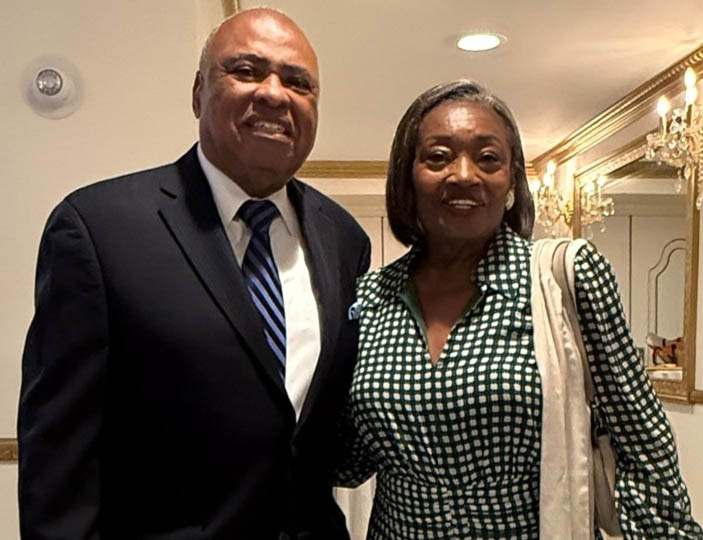
MSSNY President-Elect James E. Satterfield, MD, MBA, MS, F.A.C.S. and Senate Majority Leader Andrea Stewart-Cousins (Westchester County)
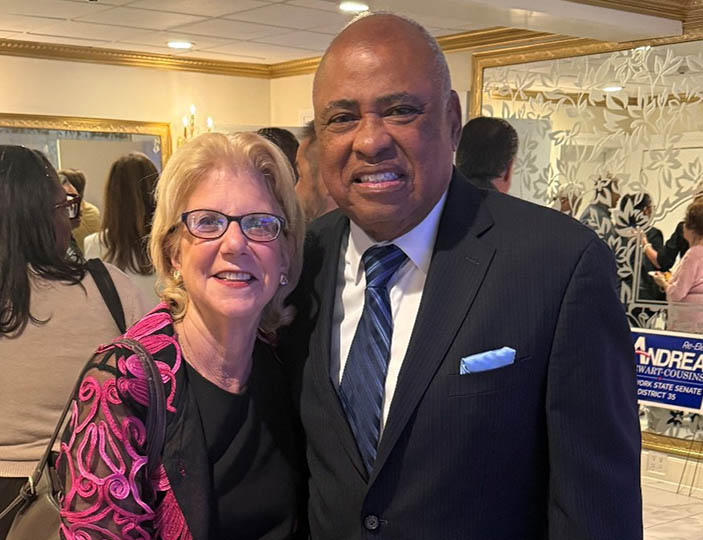
MSSNY President-Elect James E. Satterfield, MD, MBA, MS, F.A.C.S. and Senator Shelley B. Mayer (Westchester County), Chair of the Senate Education Committee and member of the Finance, Judiciary, and Labor Committees
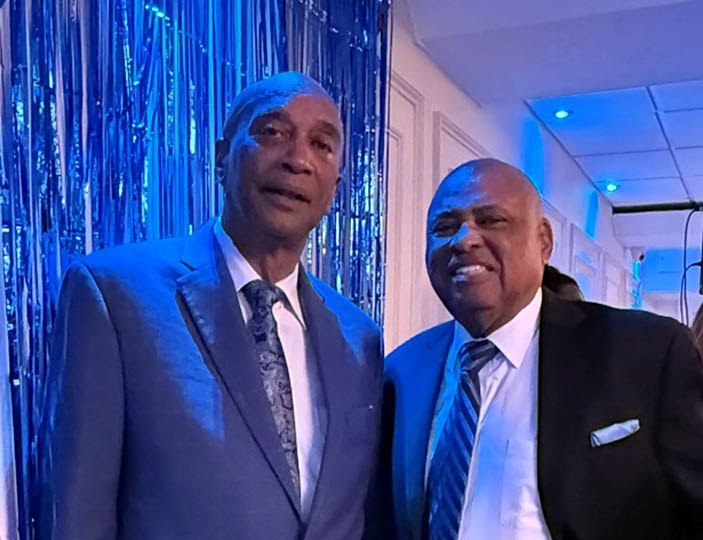
MSSNY President-Elect James E. Satterfield, MD, MBA, MS, F.A.C.S. and Assemblymember J. Gary Pretlow, Chair of the Assembly Ways and Means Committee, member of the Black, Puerto Rican, Hispanic & Asian Legislative Caucus, and member of the Puerto Rico/Hispanic Task Force
Physician Input Needed for 2027 NYS Legislative Session

Click to Enlarge
As MSSNY gears up for the 2027 New York State legislative session, we need your help!
To help inform our 2027 legislative policy agenda, please take a few minutes to complete the following survey and tell us which of the issues included you think are most important to physicians right now: Take the 2027 Legislative Survey!
Thank you in advance for your help and participation. We will share the results in future MSSNY publications.

Big Five Coalition Urges CMS Administrator to Withdraw Dangerous Medicare Payment Proposal

Click to Enlarge
In a recent letter to Dr. Mehmet Oz, Administrator for the Centers for Medicare & Medicaid Services (CMS) the elected leadership of the medical societies of California, Texas, New York, Florida, and Pennsylvania, known as the Big Five Coalition, expressed strong opposition to the proposed CY 2027 reduction in the Medicare physician conversion factor and urged the proposal be dropped. Together, the five states represented by the coalition are home to more practicing physicians than any others in the country: over 400,000 physicians, nearly 40 percent of the entire U.S. physician workforce.

Who Cares for New York? A Closer Look at Physician Representation

Click to Enlarge
By Subhash Chandra, MD, DFAPA
New York’s physician workforce reflects both the strength and the challenges of a diverse healthcare system. International medical graduates (IMGs) make up a substantial share of the state’s physicians, while Black and Hispanic/Latino physicians remain underrepresented compared with the communities they serve. These are different but related aspects of physician representation, and both deserve attention.
New York has long relied on IMGs to provide care across hospitals, clinics, and underserved communities. According to the Association of American Medical Colleges (AAMC) 2025 U.S. Physician Workforce Data, based on 2024 figures, 36.2% of New York’s active physicians were IMGs, compared with 25.6% nationally. New York remains among the states and territories with the highest proportion of IMG physicians.
The pattern goes back decades. AAMC data showed that 37.1% of New York’s active physicians were IMGs in 2020, compared with 38.4% in New Jersey, and earlier workforce data placed IMG representation at approximately 36% in 2006. For nearly twenty years, roughly one in three physicians practicing in New York has been an IMG. Their contribution matters most in the communities facing the sharpest physician shortages. IMGs are an integral part of New York medicine, not a peripheral one.

Upcoming MSSNY Webinars Support Physicians Across Every Career Stage
Click to Enlarge
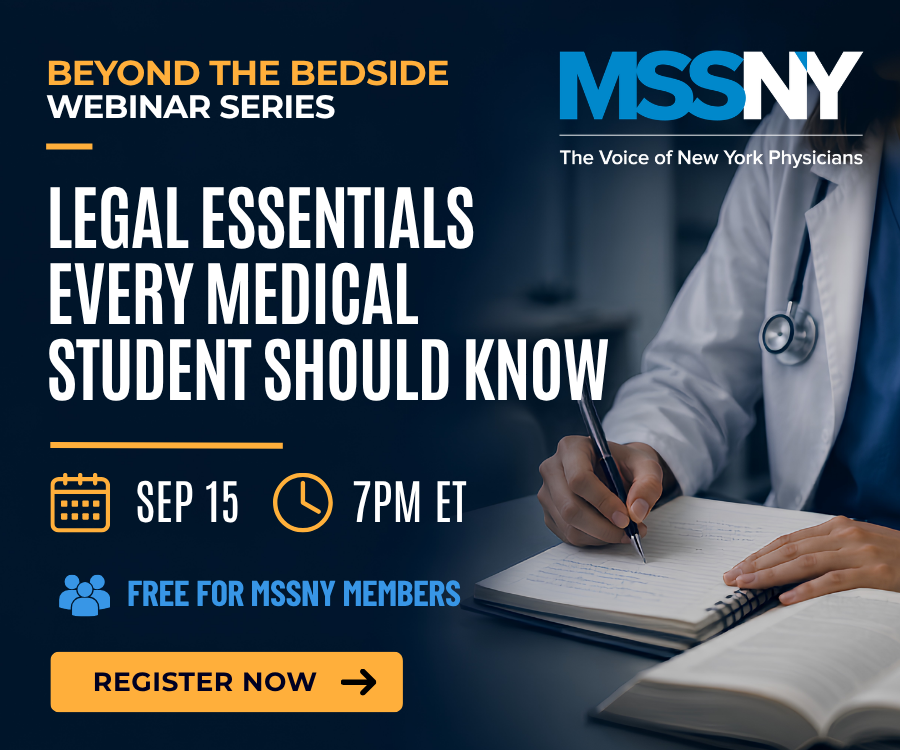
MSSNY is offering several upcoming webinars designed to help New York physicians, residents, medical students, and practice teams navigate timely clinical, legal, contractual, and reimbursement challenges. Register for the programs most relevant to your patients, your practice, and your professional future.
September 15, “From Social Media to the Medical Setting: What Every Medical Student Should Know,” will help medical students understand the legal and professional responsibilities that can affect their future. Topics include professionalism, ethical conduct, social media use, patient privacy, HIPAA, licensing, disciplinary consequences, and common legal risks to avoid during training and early practice.
September 16, “Medical Matters: Measles & Other Vaccine-Preventable Diseases: Nuances of Vaccine Confidence,” will help physicians respond to recent measles activity, ongoing outbreaks, and the resurgence of other vaccine-preventable diseases. Faculty William Valenti, MD, and Craig Katz, MD, will review epidemiological trends, immunization guidance, vaccine confidence, and evidence-based communication strategies to strengthen patient and caregiver trust. This live activity is designated for a maximum of 1.0 AMA PRA Category 1 Credit™.
September 24, “The No Surprises Act Explained: What Every New York Physician Needs to Know,” will help practicing physicians better understand how the law affects out-of-network reimbursement. Fernando J. Valencia of Callagy Recovery and Thomas Lee, MD, MBA, Executive Vice President of MSSNY, will explain when the law applies, how the Independent Dispute Resolution process works, and how physicians can identify opportunities to avoid systematic underpayment.
October 20, “Physician Employment Agreements: What to Know Before You Sign,” is designed for residents and early-career physicians preparing to evaluate employment offers. The session will cover compensation, wRVU targets, contract terms, termination provisions, call schedules, restrictive covenants, non-competes, malpractice tail coverage, and strategies for negotiating with confidence.


Simplify Your Student Debt

Click to Enlarge
Back-to-school season hits physicians, too. College Ave makes refinancing and parent loans easy with competitive rates and flexible repayment plans.


Office Space for Rent — Flatiron District
30 Central Park South Office Space for Lease
Office Space Available for Ophthalmologist in Midtown Manhattan
FOR SALE – Aesthetic Medical Equipment
Professional Office Co-Ops For Sale – Rockville Centre, NY
Prime Midtown Boutique Medical Office Sublease
On Park Ave at 80 St: Large and Beautiful Office to Share
Medical Office for Sale Upstate
Treatment Room for Sublet Near Grand Central Terminal
Medical Shared Office Space for Lease in Manhattan (Upper East Side)
Empire State Medical, Scientific & Educational Foundation Needs Peer Reviewers