What Does it Mean to be a Physician in the Age of AI?
Friday, October 23, 2026

Know Your Worth with MSSNY’s New Career Care Center
Click to Enlarge
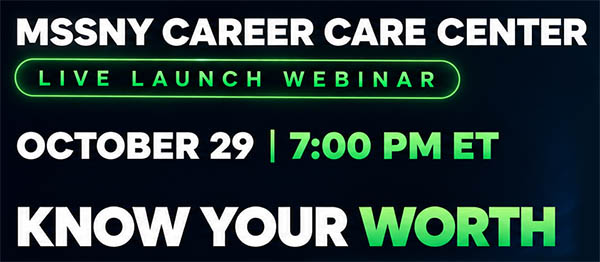
MSSNY will launch its new Career Care Center, powered by mduo, with a special webinar on October 29 at 7:00 PM ET. During this live demonstration, members will learn how to access compensation benchmarks, review employment contracts, explore career opportunities, ask questions, and use the platform’s AI powered career tools.
Register for the Career Care Center Launch Webinar
At every stage of a physician’s career, important decisions arise—from evaluating a first job offer to negotiating a contract renewal or considering a move to a new practice. Too often, physicians make these decisions without reliable information about their market value or a clear grasp of complex contract terms.
The Career Care Center is a new benefit of your MSSNY membership, created specifically for New York physicians. Members will have access to:
- New York-specific salary and compensation benchmarks based on specialty and career stage
- AI-powered contract analysis that explains key agreement terms in plain language
- Early access to physician opportunities across New York
- Career Care AI, a confidential resource for professional and career questions
The platform also takes a more personalized approach to job matching. Physicians can create confidential profiles highlighting their specialty, experience, preferred location, compensation expectations, and career priorities. Employers’ open positions are deeply analyzed, and mduo’s technology identifies potential matches based on both sides’ needs and preferences. MSSNY members can also earn a $1,000 referral fee for referring a physician who is successfully placed through the platform, compared with the standard $500 referral fee.
Want to post a position? Need help finding physicians for your team? MSSNY members receive the low mduo rate of $18k per successful recruitment
Access is simple. Your account is already set up, so you can sign in with your existing MSSNY username and password. There is no separate account or additional login to create.

AI and the Practice of Medicine: Accountability, Responsibility, and the Changing Role of the Physician

Click to Enlarge
By Donald E. Moore, M.D., M.P.H.
On September 14, 2026, I attended AI and the Practice of Medicine: Examining Accountability and Responsibility in the AI Era in Washington, D.C. The meeting brought together national leaders from the American Medical Association (AMA), the Federation of State Medical Boards (FSMB), industry, academia, and other sectors of healthcare to examine an increasingly important question: Who is accountable when artificial intelligence participates in medical decision-making?
Organizational leaders announced that an AI work group would prepare a report based on the meeting. The discussions highlighted several issues that will be increasingly important to physicians, medical societies, regulators, and patients.
From AI as a Tool to AI as a Practitioner
Keynote speaker Ezekiel Emanuel challenged the conventional view of AI as simply a tool used by physicians. Drawing upon his previous writings and studies of AI performance, he discussed evidence suggesting that autonomous AI systems can, in certain settings, outperform physicians working alone and physicians working with AI.

MSSNY Urges Support for H.R. 9693 (Patients First Act)

Click to Enlarge
MSSNY is urging members of the New York Congressional delegation to cosponsor the bipartisan Patients First Act (H.R. 9693), a comprehensive, bipartisan bill introduced in the U.S. House of Representatives in July 2026 that would finally make critically needed structural changes to prevent proposed cuts and create a payment system that helps ensure that seniors have access to quality, value-based healthcare.
The Patients First Act (H.R. 9693) addresses three core reforms that MSSNY has long supported:
- Establish automatic, annual inflation-based payment updates.
- Modernize budget-neutrality policies.
- Create simplified and clinically relevant quality measurement.
MSSNY is working with the AMA on this issue and added its name to a letter to the bill’s lead sponsors, along with a host of other state medical associations, expressing strong support. Moreover, four members of New York’s Congressional delegation have signed on as cosponsors of the bill:
- Representative Tim Kennedy (D- Buffalo)
- Representative George Latimer (D- White Plains)
- Representative Joe Morelle (D- Rochester)
- Representative Tom Suozzi (D- Glen Cove)
The importance of passing the Patients First Act (H.R. 9693) cannot be overstated, and MSSNY will continue to urge support from New York delegation members and advocate for passage.
Workers’ Comp Board Enacts Regulations to Increase Deposition Fees Starting in 2027

Click to Enlarge
The New York State Workers’ Compensation Board (WCB) has adopted regulations effective January 1, 2027, that increase the fees when a physician participates in a deposition treating an injured worker covered by Workers’ Compensation.
When a deposition is required by a physician, the fee is $500 for the first hour or fraction thereof and $125 for each additional 15-minute increment or fraction thereof, if the fee is paid within 45 days of the deposition. If the fee is paid 46 or more days after the deposition, the fee is $700 for the first hour or fraction thereof and $125 for each additional 15-minute increment or fraction thereof. Submission of a bill, including the CMS-1500, is not necessary, nor is a WCB decision required to direct deposition payment.
If a deposition fee has not been paid within 45 days of the deposition, a health care provider may file a Request for Decision on Unpaid Medical Bill(s) (Form HP-1.0) just as they would for an unpaid medical bill. When submitting the HP-1.0 form for payment of a deposition fee, health care providers must attach a Deposition Testimony Affirmation (available 1/1/27) as a PDF.
The WCB notes that the affirmation must be attached in place of the required medical bill/CMS-1500 when requesting payment of a deposition fee. When prompted to attach the required medical bill in the submission of Form HP-1.0, please submit the Deposition Testimony Affirmation. Please do not submit the Deposition Testimony Affirmation to the Workers’ Compensation Board separately, as it must be attached with the online submission of Form HP-1.0.
The Form HP-1.0 must be submitted within the same 165-day timeframe as a request involving any other billing dispute. This means that the Form HP-1.0 and accompanying Deposition Testimony Affirmation must be submitted no earlier than 45 days and no later than 165 days from the date of the deposition.
This is another step from the WCB in an effort to increase participation of physicians in the Workers’ Compensation program through increased payments for care rendered and reduced administrative hassles.
MSSNYPAC Endorsements for Election

Click to Enlarge
At its September 17 meeting, the MSSNY Council affirmed MSSNYPAC’s recommendations to endorse 39 candidates who have demonstrated strong support for issues affecting New York physicians and their patients.
MSSNYPAC’s state and federal candidate subcommittees and its Executive Committee conducted the endorsements following evaluations. These candidates have demonstrated a commitment to issues important to the medical profession and patient care.
Advocacy in Action

Click to Enlarge
MSSNY-PAC co-hosted a reception for Senator Jessica Scarcella-Spanton, Chair of the Senate Committee on Veterans, Homeland Security, and Military Affairs, and a member of the Senate Committees on Labor, Women’s Issues, and Disabilities.

Pictured clockwise:
- Photo 1: From left to right: Dr. Arthy Yoga (RCMS, new MSSNY-PAC volunteer), Senator Scarcella-Spanton, Dr. Ana Mendez (former RCMS President), and Dr. Lance Austein (RCMS).
- Photo 2: Senator Scarcella-Spanton with Dr. Austein.
- Photos 3: Senator Scarcella-Spanton with Dr. Alex Shteynshlyuger (KCMS, new MSSNY-PAC volunteer).
- Photo 4: Senator Scarcella-Spanton with Dr. John Lombardo (MLMIC).
- Photo 5: Senator Scarcella-Spanton with Dr. Radha Syed (RCMS).
- Photo 6: Senator Scarcella-Spanton with Dr. Alex Shteynshlyuger (KCMS, new MSSNY-PAC volunteer).
Physician Input Needed!

Click to Enlarge
Physicians continue to report insurer payment delays that strain practice revenue, staffing, and administrative workflow. MSSNY is gathering input to support stronger Prompt Payment enforcement and help shape advocacy for the 2027 legislative session.
Please complete the Prompt Payment survey to share your experience with delayed insurer payments and complaint response times: https://www.surveymonkey.com/r/9WR8P6J
Then take the 2027 Legislative Survey to tell MSSNY which issues should be prioritized for New York physicians: https://www.surveymonkey.com/r/66LSXSV

Provider-Administered Drugs Webinar Update

Click to Enlarge
NYRx, the Medicaid Drug Program, will host an additional webinar on PADs (Provider-Administered Drugs) on Monday, November 9 at 10:00 AM. Physicians are welcome to attend. The presentation will share updates and provide additional information about resources and support. There will also be time for Q&A.
- Date: Monday, November 9, 2026
- Time: 10:00-11:00 AM Eastern Time
- Register here.
- Submit your questions ahead of the webinar. Please submit questions by Monday, November 2

MSSNY Member Criticizes New Excellus Reimbursement Policy

Click to Enlarge
In a letter to the editor of the Syracuse (NY) Post-Standard (10/15), MSSNY member Dr. Brian Raphael discusses Modifier 25, a new Excellus BlueCross BlueShield reimbursement policy that “applies when a patient receives a medically necessary office visit and a separate, medically necessary procedure on the same day.” The “new policy reduces reimbursement for the lower-cost service when both are provided together.” Dr. Raphael writes that “Excellus says the policy is not intended to encourage separate visits,” but “our concern is the unintended consequence: reducing reimbursement for providing these services together could discourage same-day care that saves patients another appointment, time away from work or family, and treatment delays. We aren’t alone in raising concerns. The American Medical Association (AMA), NYS Society of Dermatology and Dermatologic Surgery, Medical Society of the State of New York and American Academy of Dermatology have met with Excellus.” Dr. Raphael adds, “We urge Excellus to work with physicians toward a solution that protects efficient patient care and preserves access to independent medicine in Central New York.”
MSSNY has shared this media coverage with the NY Department of Financial Services to urge that they step in to prevent this cut from moving forward. Physicians can assist in this effort by sending a letter to their legislators, Oppose Health Insurer Cuts to Same-Day Care (Modifier 25) for Patients, urging that they support legislation to prohibit all health insurers from implementing these types of cuts.

MSSNY’s Respiratory Viruses 2026–2027 Webinar, Replay Available Now

Click to Enlarge
As the 2026–2027 respiratory virus season unfolds, physicians face important decisions about influenza, COVID-19, and RSV prevention, vaccination, and treatment.
MSSNY’s Respiratory Viruses 2026–2027 webinar, featuring Infectious Diseases Committee Chair William Valenti, MD, focuses on immunization guidance, pediatric RSV prophylaxis, vaccine confidence, and clinical workflows for rapid testing and treatment. Watch Now

Upcoming MSSNY Webinars Support Physicians Across Every Career Stage
Click to Enlarge
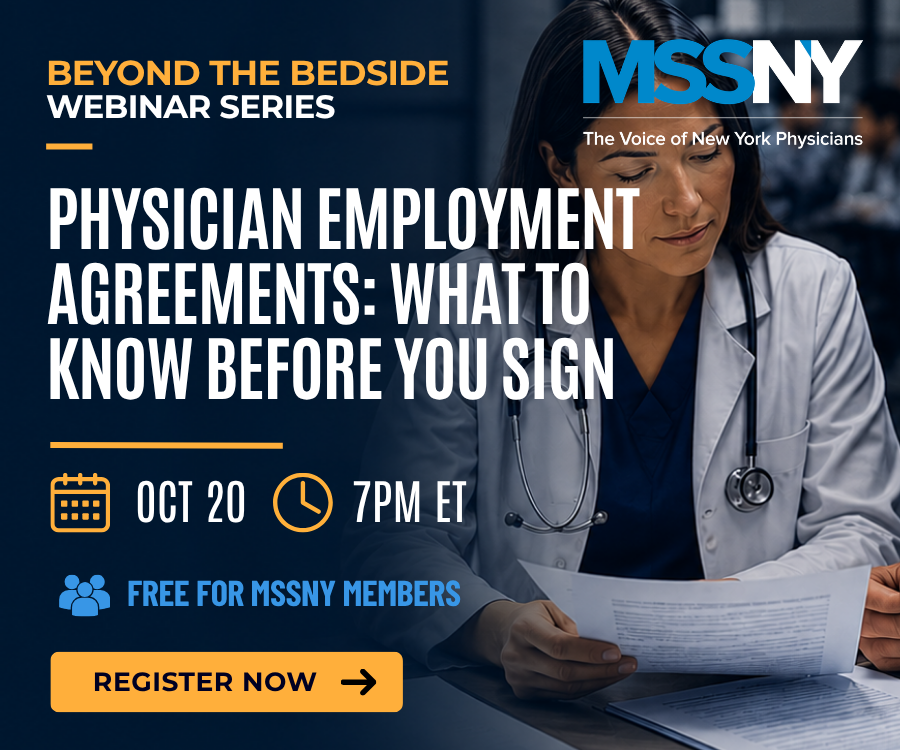
October 27
Beyond the Office Visit: How Chronic Care Management Can Improve Care, Quality & Revenue. Learn how Chronic Care Management and other value-based care strategies can help independent practices extend support beyond the office visit, improve patient outcomes, and create recurring revenue. Dr. Cedrick Batchateu will share practical approaches for integrating care coordination, medication management, and patient engagement into existing workflows without adding unnecessary burdens for physicians or staff.
November 4
The Art of Seeing: Art, Observation, and Physician Wellbeing. Join MSSNY to examine how art-based observation and engagement can support physician wellbeing and reflective practice.
November 10
Beyond Patient Care: The Legal Risks No One Taught You About. This webinar will explore the federal and New York State fraud and abuse laws that affect every day medical practice.

Financial Planning for Physicians
Click to Enlarge
Physicians face unique financial challenges, from retirement planning and tax strategies to practice transitions and wealth preservation. Through MSSNY’s partnership with Altfest Personal Wealth Management, members have access to fiduciary guidance tailored to the realities of a medical career.
Altfest’s team provides comprehensive financial planning designed to help physicians make informed decisions, reduce uncertainty, and build long-term financial confidence.
Take the next step toward your financial future. Schedule a Consultation