Honoring Physicians in Uniform
Friday, November 6, 2026

Honoring Physicians in Uniform

Click to Enlarge
Colleagues:
On Veterans Day, our nation pauses to honor the men and women who have served in the United States Armed Forces. We recognize their courage, their sacrifices, and their commitment to protecting our country and the freedoms we cherish. Among these veterans is a special group, the physicians who have dedicated all or a portion of their careers to serving in the military.
For many, military service has meant practicing medicine under circumstances few civilian physicians will ever encounter. Caring for casualties in combat zones requires not only clinical expertise, but also the ability to make difficult decisions under extraordinary pressure. Military physicians must often balance the needs of individual patients with the realities of a larger mission, all while working in environments where danger is an ever-present consideration. Their work demands adaptability, sound judgment, teamwork, and a commitment to the patients entrusted to their care.
We must also recognize physicians who devoted a portion of their careers to military service before returning to civilian practice. Their commitment did not end when they took off their uniforms. They brought with them experiences that shaped their clinical judgment, strengthened their appreciation for teamwork, and deepened their understanding of the relationship between service and responsibility. In communities across New York State, these physicians continue to care for patients, teach future physicians, and contribute to the health of the public.

CMS Announced 2027 Medicare Payment Rule AGAIN Cutting Physician Payments 2.3%; Physician Advocacy Needed to Their Members of Congress

Click to Enlarge
The Center for Medicare & Medicaid Services (CMS) released its final rule for 2027 Medicare physician payment this week, implementing a 2.31% conversion factor cut for a non-Alternative Payment Model (APM) health care services, and a 1.83% conversion factor cut for APM services. The cut reflects a few different factors, most impactfully, the sunset of the temporary +2.5% increase that had been included as part of HR 1 enacted in 2025.
Please see the American Medical Association’s summary of the payment rule.
MSSNY President Dr. Mark Adams issued a statement criticizing CMS for this step and calling for legislation (HR 9693) to stop this and future Medicare cuts.
Physicians can send a letter to their members of Congress here urging the passage of HR 9693, the Patients’ First Act, to replace cuts in future years with increases. Congress will be back in DC in December for a “lame duck” Session to pass spending bills, and organized medicine is urging that this bill be included.
Modifier-25 Changes. Also problematic in the final version are cuts to healthcare services delivered on the same day, though the final version was materially scaled back from the proposed version after sustained advocacy by MSSNY, AMA and more than 150 state and specialty societies (sign-on letter). CMS initial proposed to cut payment by 50% when an office/outpatient E&M visit is reported with modifier -25 on the same day as a global procedure. In the final rule, CMS instead:
- limits the policy to 0-day global procedures only, dropping 10- and 90-day global procedures.
- reduces payment for lower-valued same-day service(s) by 20% rather than 50%;
- applies the policy only to services furnished by the same physician or a physician of the same specialty in the same group practice, so same-day services by physicians of different specialties in the same group are not affected.
The policy applies to office/outpatient E/M visits and takes effect January 1, 2027. CMS estimates the largest impacts will still fall on dermatology and otolaryngology.
Physicians are urged to contact their State Senators and Assemblymembers to ask that they support legislation (A11688, Weprin) to prevent private health insurers from imposing similar cuts.
Tuesday’s Election Results Expand Democratic Majorities in State Legislature and Put New Yorkers in Leadership Positions in Congress

Click to Enlarge
As has been widely reported, the elections this week produced numerous Democratic victories both in New York State and across the country. Of particular note:
- Governor Kathy Hochul, Attorney General Letitia James and Comptroller Thomas DiNapoli each won re-election by substantial margins.
- Based upon which candidates have been declared winners or who are leading at this point (with votes still to be counted), it appears the Democrats will have a 47-16 Democratic majority in the State Senate and a 111-39 or 112-38 majority in the Assembly, creating again what is technically a “veto-proof” majority.
- There will be over 40 new members in the State Legislature including the defeat of numerous incumbent State Senators and Assemblymembers in Long Island, Brooklyn, Hudson Valley and the Capital District.
- For Congress, Brooklynites Hakeem Jeffries and Charles Schumer will likely lead the US House of Representatives and US Senate after both parties flipped enough seats across the country to gain majorities in both Houses, with Democrats controlling at least 54 seats of the 100-person US Senate and 253 of the 435-person US House of Representatives. In New York , Democrat Cait Conley defeated incumbent Republican Michael Lawler in NY-17 (lower Hudson Valley). Also, notably, while not a flip in control, Republican Anthony Constantino is leading Democrat Blake Gendebien in North Country Congressional race (NY-21) to replace Elise Stefanik.
There are numerous websites for physicians to view who has won or who is currently leading in the various New York elections, including here and here.
We will follow-up with additional information about these newly elected officials from across the State, and how MSSNY and county medical society leadership will be working together to develop and expand relationships with them.
Advocacy in Action

Click to Enlarge
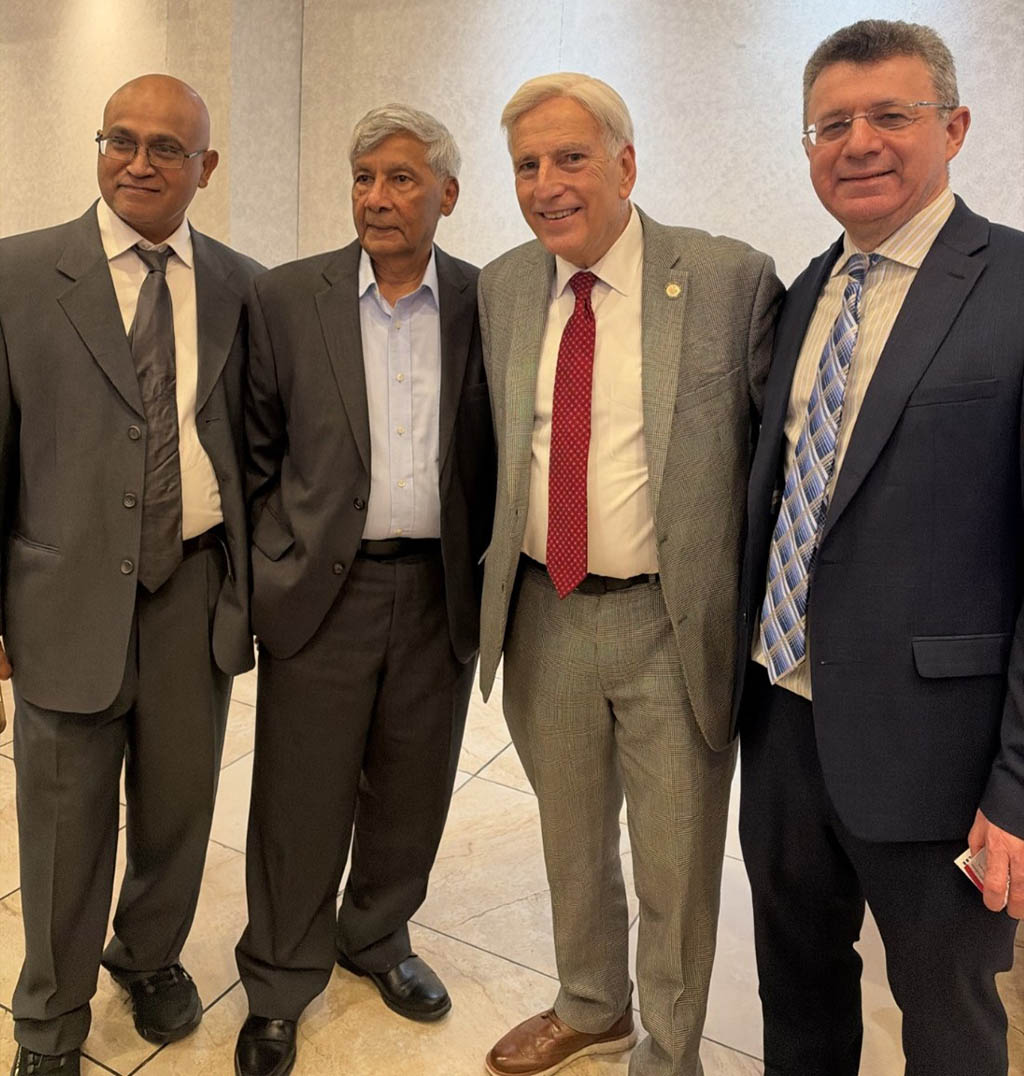
Dr. Alex Shteynshlyuger attending the October 15 reception in Queens for the Chair of the Assembly’s Insurance Committee, David Weprin.

New Cybersecurity Pilot for Rural Hospitals

Click to Enlarge
- Key Point: The federal government launched Project Lifeline 250, a six-month cybersecurity pilot offering free technology and services to participating rural hospitals.
- Why it Matters: Cyberattacks can interrupt patient care, compromise sensitive information, and threaten hospital operations.
- Program Benefits: Participating hospitals will receive cybersecurity upgrades, backup technology, and assistance identifying vulnerable equipment.
New York physicians working in rural and community hospitals, cybersecurity threats are more than an information technology concern. Cyberattacks can disrupt patient care, compromise sensitive information, and interrupt essential clinical services, placing additional pressure on healthcare teams already managing limited resources.
On October 26, 2026, the White House Office of the National Cyber Director and the Department of Health and Human Services launched Project Lifeline 250, a six-month pilot program providing free cybersecurity technology and services to participating rural hospitals. The initiative begins in South Carolina, with the goal of identifying solutions that could strengthen healthcare cybersecurity nationwide.
Study Finds Safety Gaps in AI Medical Advice

Click to Enlarge
As artificial intelligence becomes more widely used in clinical care, new research highlights both its potential benefits and patient safety risks. The NOHARM (Numerous Options Harm Assessment for Risk in Medicine) study evaluated AI-generated recommendations across 1,100 clinical consultation scenarios and identified potentially severe errors in 2.9% to 24.6% of cases, depending on the system, with more than 80% of severe errors involving omissions.
The study also found that AI assistance improved physician performance, reinforcing the importance of effective physician-AI collaboration, rigorous clinical safety evaluations, and clear accountability as these technologies become integrated into patient care.
First, Do NOHARM: A Medical Safety Benchmark and Randomized Study of Physician and AI Teaming on Clinical Consultations (Wu et al., arXiv, 7/13).

A Warm Welcome to Our New October MSSNY Members!
Click to Enlarge
Albany County
Joseph Clinton McCabe, MD
Aixa Toledo, FACP
Broome County
Mohammed Ahmer Siddiqui, MBBS
Delaware County
Christopher Kotsis, MD
New York County
Caroline Ensor, MD, MBA
Javier Martin Perez, MD
Queens County
Mohamed Mahmoud Sabour, DO
Saratoga County
Milanka Stevanovic
Westchester County
Kamal Addagatla, FACS

MSSNY Urges Congress to Protect Seniors’ Access to Care Amid 2027 Medicare Payment Cuts

Click to Enlarge
The Medical Society of the State of New York (MSSNY) is calling on Congress to take action against additional Medicare physician payment cuts proposed for 2027, warning that continued reductions threaten seniors’ access to community-based medical care. In a statement, MSSNY President Mark J. Adams, MD, MBA, FACR, highlighted the financial challenges facing independent physician practices and the potential for further healthcare consolidation. MSSNY is urging Congress to pass the Patients First Act (H.R. 9693), which would establish annual Medicare physician payment updates that reflect the rising costs of running a medical practice.

Antisemitism in American Healthcare: From Research to Action

Click to Enlarge
On Wednesday, November 18th at 12 PM, this timely discussion will explore findings from three new qualitative research reports examining the experiences of Jewish medical students, healthcare professionals, and patients across the American healthcare system.
Through a moderated panel discussion, we will highlight key themes emerging from the research, examine how antisemitism manifests across healthcare settings, and discuss the steps institutions can take to address discrimination, strengthen accountability, and foster safer, more inclusive environments. Register Now
Upcoming MSSNY Webinars Support Physicians Across Every Career Stage

Click to Enlarge
November 10
Beyond Patient Care: The Legal Risks No One Taught You About. This webinar will explore the federal and New York State fraud and abuse laws that affect everyday medical practice.
November 11
Closing the Knowledge Gap in Menopause Care. Queens County will host this webinar; the faculty is Monique De Four Jones, MD, MBA, MS.
November 18
Beyond the Acute Infection: A Mechanism-Based Approach to Diagnosing & Managing Post-Viral Syndromes. Learn more about diagnosing and treating patients experiencing Long COVID and other post-viral syndromes, with Robert Groysman, MD, Founder of Southwest Pain Management and the COVID Institute in Texas.
Antisemitism in American Healthcare: From Research to Action. Examine how antisemitism manifests across healthcare settings and discuss the steps institutions can take to address discrimination, strengthen accountability, and foster safer, more inclusive environments.
December 2
The Insurance Mistake Physicians Can’t Afford to Make. What Every Physician Should Know About Disability Insurance.
December 8
Beyond the Bedside: Protect Your Practice. Common legal and financial risks in practice arrangements and how to reduce exposure.

Enjoy The Season—Without Overspending

Click to Enlarge
Celebrate gratitude with savings. MemberDeals gives MSSNY members holiday discounts on entertainment, travel, and family experiences.